From the Editor / Across the Eras
Inside The Ring Where It Counts
For the stories we believed in, the performers who brought them to life, and the art of professional wrestling.
I was just a kid when my older brother introduced me to professional wrestling. He introduced me to a lot of things I still love today. Batman. Anime. Video games. But wrestling was different. Wrestling got hold of me in a way I didn't entirely understand at the time.
And one of the first people responsible was Tatanka. Tatanka was just cool. The headdress, the Native American imagery, the power, the pride. He looked like a warrior. Someone you could believe in.
Then there was Irwin R. Schyster. IRS.
The devil in suspenders.
Everything about that man seemed designed to make you dislike him. And when these two crossed paths, I found myself experiencing something that would stay with me for the rest of my life.
On an episode of WWF Superstars in April 1994, IRS attacked Tatanka following a match against Kwang. He trapped Tatanka's arms between the ropes, leaving him helpless, almost crucified, and began tearing apart his ceremonial headdress.
Feathers everywhere.
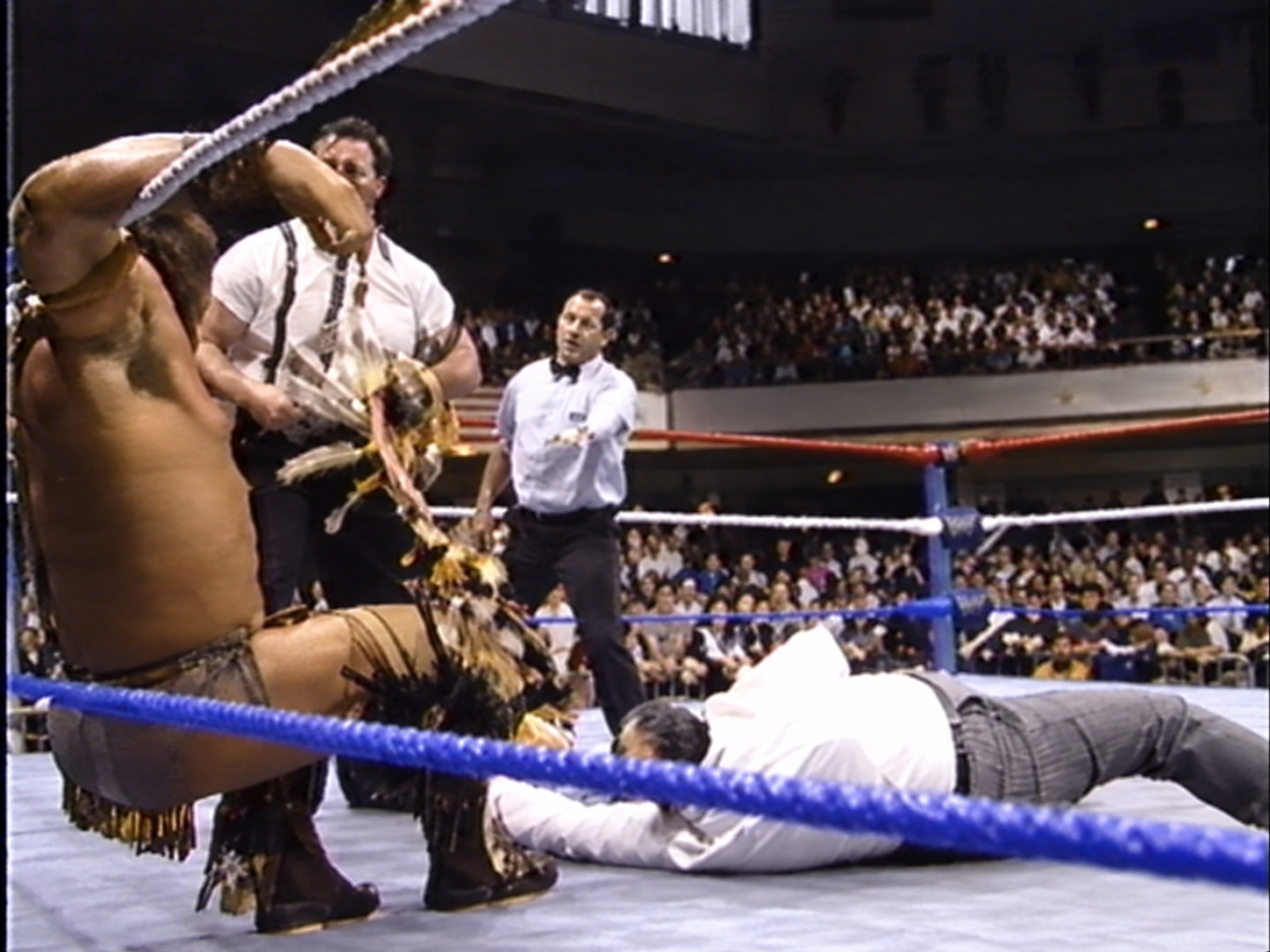
Tatanka could only watch. For one young fan, seeing him helpless in those ropes was the beginning of a lifelong connection to professional wrestling.¹
Tatanka couldn't defend himself. He couldn't stop the humiliation. I watched this noble warrior being subjected to something that, in my young mind, was simply wrong. It was unjust. And I needed to see something done about it.
I needed Tatanka to prevail. I needed the bad guy to get what was coming to him. I needed to know that what I'd just witnessed wasn't how it ended. So I kept watching.
I couldn't have explained it then, but looking back, I think I understand what happened. Professional wrestling had made me feel something. And isn't that what great art is supposed to do?
All the World's a Stage
The world can be a cold place. Life has a way of demanding so much of us that, somewhere between work, responsibilities, disappointment, and the ordinary difficulties of being an adult, we can forget what it feels like to become completely absorbed in something. To care without reservation. To cheer. To get angry. To feel the satisfaction of a wrong being made right.
Professional wrestling gives us that opportunity. It is a stage for morality, suffering, triumph, defeat, betrayal, and redemption, all brought together in one live art form.
And what an extraordinary art form it is. Athleticism, theater, improvisation, physical performance, and storytelling, all unfolding before an audience. Sometimes a story takes months or years to reach its conclusion. Sometimes it is told almost entirely through movement, without anyone speaking a word.
And the people creating it do so with their bodies. They fall. They collide. They exhaust themselves. They work through pain. They travel. They sacrifice time with their families. They spend years, sometimes decades, building characters and relationships that become part of other people's lives.
The outcomes may be predetermined. The work is not imaginary. And neither is what we feel watching it.
What Roland Barthes Understood
In 1957, French philosopher and cultural critic Roland Barthes published Mythologies, a collection of essays examining the meanings we attach to everyday cultural experiences. One of those essays was titled "The World of Wrestling."
Barthes recognized something about professional wrestling that I think is as relevant today as it was nearly seventy years ago. He called wrestling a "spectacle of excess." He understood that wrestling made human emotions visible. A wrestler didn't merely suffer; he showed suffering in a way that could be understood throughout the arena. A villain's cruelty was unmistakable. A hero's struggle was recognizable. Justice, when it finally arrived, could be experienced by everyone.
Barthes wrote:
"What the public wants is the image of passion, not passion itself."
Think about that. We don't need to believe an actor is actually suffering to be moved by a performance. We don't need to believe the events in a film actually happened to become invested in its characters. We understand the nature of the performance. Yet we still feel.
Barthes was writing about wrestling in a different era, but he recognized the emotional language of the art.
When IRS trapped Tatanka in those ropes, I didn't need someone to explain the story to me. I saw a man who couldn't defend himself. I saw someone abusing his power. I saw humiliation and cruelty. And I wanted justice.
I was seven at the time, watching wrestling on television. Yet I was experiencing precisely the sort of emotional spectacle Barthes had described decades earlier. That's remarkable when you think about it.
Still a Fan on the Other Side
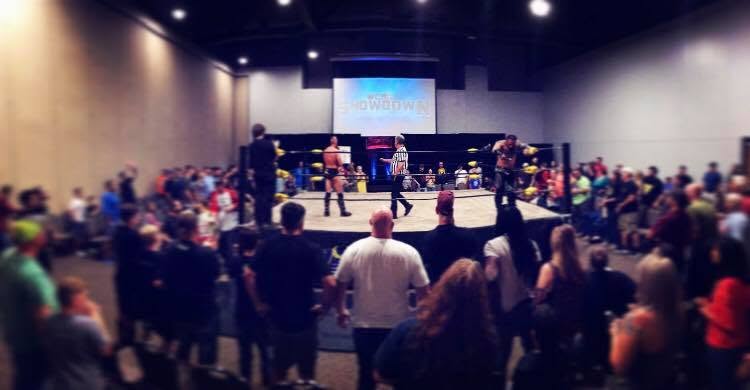
Showdown Redemption, August 2019. From my years promoting professional wrestling.
Years later, I found myself on the other side of professional wrestling. I became a promoter. As a promoter, I've had the privilege of helping bring wrestling to audiences in multiple states. I've been involved in developing characters, constructing rivalries, organizing events, and creating the stories we asked our wrestlers to bring to life.
But there's something interesting about how I've always approached that work. I don't particularly want to know everything.
I can give a wrestler theatrical direction. I can explain the characters, the conflict, where the story needs to go, and what I want the audience to feel. But I don't need to tell the wrestlers how to work their match. I don't need to ask them afterward how they accomplished a particular spot or sequence. I intentionally preserve some of that mystery for myself.
Think about what these men and women do. You give them a story. You establish the emotional stakes. Then they go into a ring, in front of a live audience, and bring it to life.
One live take.
With sweat, fatigue, physical consequences, and an audience reacting to everything they do. Some of us can't even type on a keyboard while being watched. And they have to respond to that audience while the performance is happening.
You can't tell me that's not art. It's incredible. Even after being involved in the business, my brain still struggles to fully comprehend the craftsmanship required to do it well.
One of my favorite memories from running shows involved a championship tag-team match between a team the crowd had come to despise and two challengers they desperately wanted to see win.
The villains (kind of like our Four Horsemen) had spent a long time making life miserable for everyone around them. They had a habit of finding ways to win, even when the audience desperately wanted to see them lose. And the crowd hated them for it. That wasn't something accomplished in one evening. The investment had been built over a year or two of stories, confrontations, and matches.
Then came the championship match. All four men were excellent workers. They went out there and delivered. And when the challengers finally won, the place erupted.
A genuine emotional release. People had followed the story, endured the frustration, and finally witnessed the result they wanted. I had helped construct the circumstances, but those wrestlers made the moment real to the audience.
For a moment, I was that kid just watching wrestling again. Except this time I had been fortunate enough to help give somebody else that feeling. That's what professional wrestling can do.
When the Curtain Became the Attraction
I remember when the internet began making the wrestling business more accessible. Wikipedia was particularly "dangerous" for me in the early 2000s. Suddenly, you could find almost anything. Wrestlers' real names, personal histories, how matches were constructed, and details of the business that had once remained largely out of view.
I remember learning things and thinking, Yeah, I think I'm going to stop right here. Not because I didn't understand what wrestling was. I understood enough. But I didn't want that understanding to interfere with what I still enjoyed about watching it.
Today, the curtain has been pulled back farther than ever. We discuss creative control, contract disputes, disagreements with management, television ratings, backstage arguments, and who made the decision for one wrestler to defeat another. Even wrestling itself increasingly turns its own production process into entertainment, as we've seen with Netflix's WWE: Unreal.
There is a place for all of that. The business of professional wrestling has a fascinating history, and the people who work in it have legitimate stories worth examining.
But I sometimes wonder what we're losing along the way. I don't imagine Ric Flair, Sting, The Undertaker, Hulk Hogan, or Shawn Michaels dedicated their lives to creating these extraordinary characters because they wanted generations of fans to spend most of their time discussing disagreements with their employers.
Imagine watching Marlon Brando deliver an extraordinary performance, only for the conversation to become almost entirely about the production company's finances and the disagreements that took place during filming. Those subjects may be interesting.
But what about the performance? What about the work? What about what the artist gave us?
There was a time when The Undertaker emerged from the darkness, the music began, and a chill went through the audience. Who was this man? What cemetery had let him off work long enough to come kick somebody's ass and head back to his coffin?
We didn't need to know. That was part of the wonder.
And Shawn Michaels? That conceited son of a gun could make you want to see somebody knock the arrogance right out of him. But good grief, could that man wrestle. We could appreciate that without needing another explanation of what was happening behind the curtain.
Somewhere along the way, we began treating the construction of the illusion as though it were more interesting than the illusion itself. And while I understand why, I don't believe it has to be that way all the time.
The Character Was More Than a Gimmick
Professional wrestling has another remarkable tradition. For generations, the performer's character didn't necessarily end when the match was over.
One day, Randy Poffo became known to the world as "Macho Man" Randy Savage and never looked back. Everything, from the voice and mannerisms to the clothing and personality, contributed to a character that lived far beyond the ring.
I've always thought of it a little like an observed atom in quantum physics. Bear with me; this is a wrestling fan's analogy. Whenever you saw them, you encountered the wrestler. The ring wasn't the boundary. An appearance on camera, an interview, or an encounter with a fan could become another occasion for that character to exist.
The performers understood that the character's world extended into the audience's world. Sometimes maintaining that illusion became an extraordinary commitment.
I don't believe performers owe us their private lives, and I certainly don't believe they should have to sacrifice their personal boundaries for a character. But I deeply appreciate the dedication that went into creating those identities. There is something special about a person willing to become larger than life for the audience.
And perhaps we could return some of that respect by allowing the work itself to remain the focus. Many performers are private people. They don't necessarily want every detail of their personal lives examined. They want the work they present to be appreciated.
Respect the person by appreciating the work. That feels like a reasonable place to begin.
Why The InsideCount Exists
So this is what we're trying to create. The InsideCount is a place to revisit professional wrestling from within the world its performers created.
When Ron Simmons defeated Big Van Vader for the WCW World Heavyweight Championship in 1992, we want to examine the match. How did Simmons survive Vader's offense? What openings did he recognize? How did he accomplish something that had seemed nearly impossible just weeks earlier?
When we ask who Sting's greatest tag-team partner was, we want to examine the teams, the championships, the victories, the defeats, and the caliber of opposition. Was Lex Luger his greatest partner? Darby Allin? Someone history has largely overlooked? Let's investigate.
And when we revisit the troubled family history of The Undertaker and Kane, we want to explore the accusations, the conflicting accounts, and the extraordinary relationship that eventually produced the Brothers of Destruction.
We're interested in the stories themselves.
Not who was scheduled to win. Who won. Not why a writer decided a champion should lose. How the champion was defeated. Not what happened in a production meeting. What happened in the ring.
We'll ask questions. We'll disagree. We'll examine the evidence. We'll sometimes have a little fun with the wonderfully strange world of professional wrestling. But we'll do it from inside the story.
You don't have to forget everything you know about wrestling to enjoy The InsideCount. You don't even have to agree with our approach. We're simply offering a place where, for a little while, you can set that knowledge aside and enjoy the stories the way their performers presented them.
For the Stories That Remain
There's one more human reason this matters. Every year, we lose another wrestling legend. Another performer who gave decades of their life to this art is no longer with us. And as the years go by, the audiences who experienced their greatest moments firsthand grow older, too.
We cannot keep these people with us forever. But perhaps we can help preserve what they created. Not simply their championship totals or the details of their business dealings, but the characters, the rivalries, the triumphs, the defeats, and the moments that made audiences care.
And not just those who performed in front of millions. I think about the wrestlers I've had the privilege of working with. The men and women who wrestled in smaller buildings, in front of audiences who may never see them on national television. They gave those audiences something, too. A memory. A hero. A villain. A moment worth remembering. That work matters.
I hope that years from now, someone who never had the opportunity to watch Sting in his prime can read our articles and begin to understand why he meant so much to people. I hope they can appreciate what a performer accomplished before feeling the need to know every detail about the person behind the character.
And I hope that somewhere, a young fan discovers an old wrestling story and feels something. Maybe even the way I felt watching Tatanka helpless in those ropes, wondering how anyone could be so cruel and hoping that, somehow, justice would prevail.
If we can help preserve even a little of that feeling, I believe The InsideCount will have accomplished something worthwhile.
Welcome to the Show
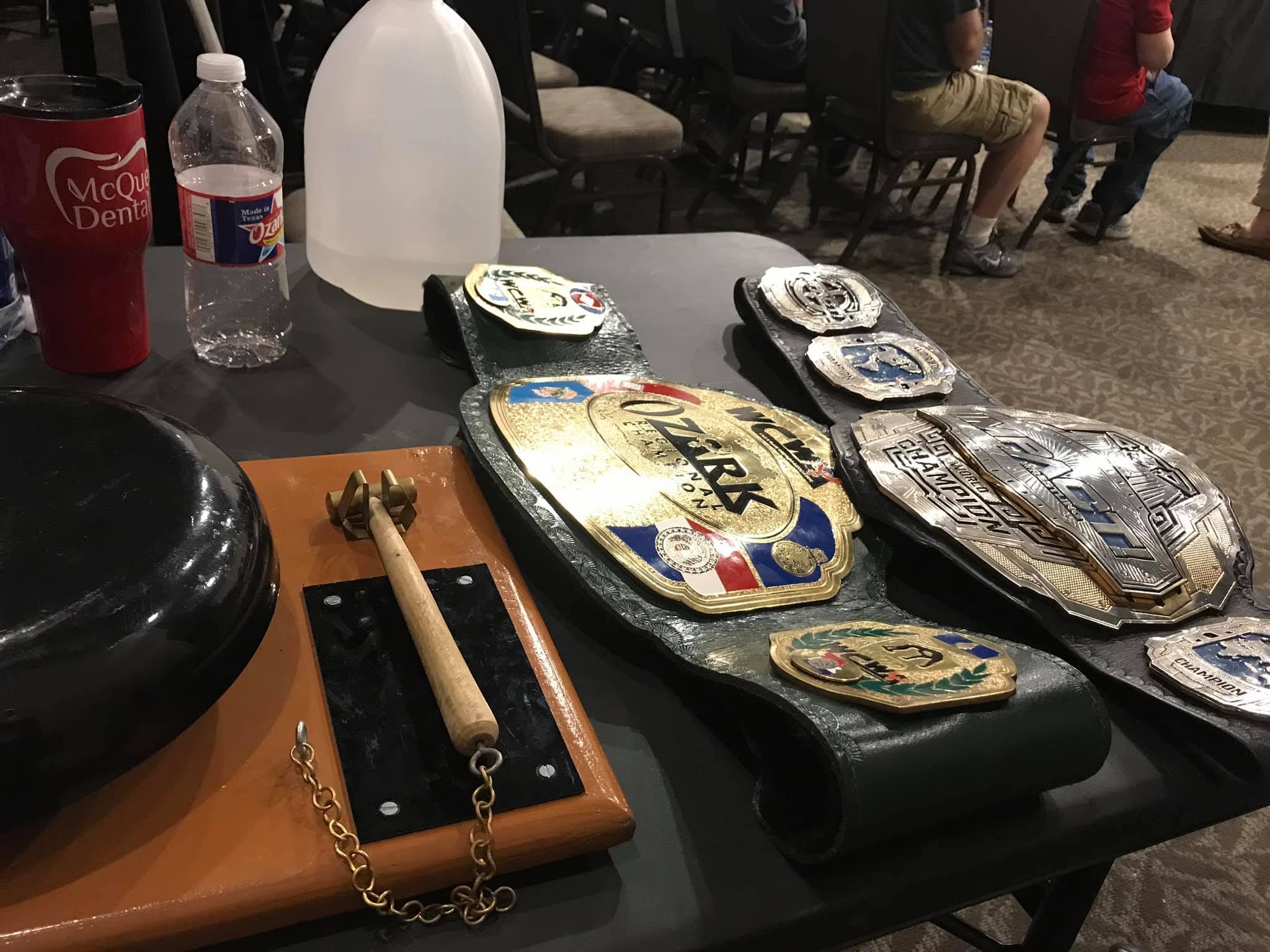
WCWA Ozark Regional Championship alongside the TNA World Championship belt at Monsters and Men, October 2019.
Here's how I imagine this place. We're all gathered in a virtual arena.
Maybe you've been a wrestling fan your entire life. Maybe you haven't watched in years. Maybe you grew up knowing every secret of the business and have never experienced wrestling quite this way. It doesn't matter.
You've got your ticket. The lights are coming down. The crowd is settling in. The show is about to begin.
For the time we're here, we're going to enjoy it. We're going to celebrate the victories, argue over the controversies, revisit the rivalries, and remember the legends who gave us so much.
When it's over, we can go back to the "real" world. The responsibilities. The arguments. The business. Everything waiting outside those doors.
But while you're here, there's a seat for you.
Leave the baggage at the door.
Welcome to the show. Please come inside.
Nathaniel T.
Founder and Editor-in-Chief
The InsideCount
Sources
1. WWF. Superstars, April 16, 1994. “IRS Vs Tatanka & Chief Jay Strongbow”, YouTube, uploaded by firstcowtails. Image at approximately 0:41. 2. POST Wrestling. “Bound for Glory Report: Brian Cage Retains Impact Title.” October 20, 2019. 3. Roland Barthes. “The World of Wrestling.” Mythologies, 1957. PDF hosted by MIT.
Image Credits
- Tatanka and IRS: WWF broadcast still. AI-enhanced; some visual details reconstructed.
- Monsters and Men, October 2019: Photograph by Nathaniel T.
- Showdown Redemption, August 2019: Nathaniel T. personal collection.
■
From the crowd
Join the conversationWhat's your take? Keep it about the wrestling. Respect the person on the other side of the ropes.
Sign in with your free membership to join the discussion. Comments are reviewed before appearing.